
I like a good cup of tea, and I like saving energy.
A British kettle is a formidable piece of equipment, able to raise the temperature of water surprisingly quickly, by putting somewhere up to 3kW of electrical energy into it.
Each 300ml of water boiled takes around 30Wh of electricity (in practice, a bit more, as kettles aren’t 100% efficient), so boiling water for say six cups a day equates to about 5.4kWh per month of energy. That’s equivalent to driving about 20 miles in an EV, 5 electric showers or 7 loads of washing. At the typical unit price, it’s about £1.42 of a monthly electricity bill.
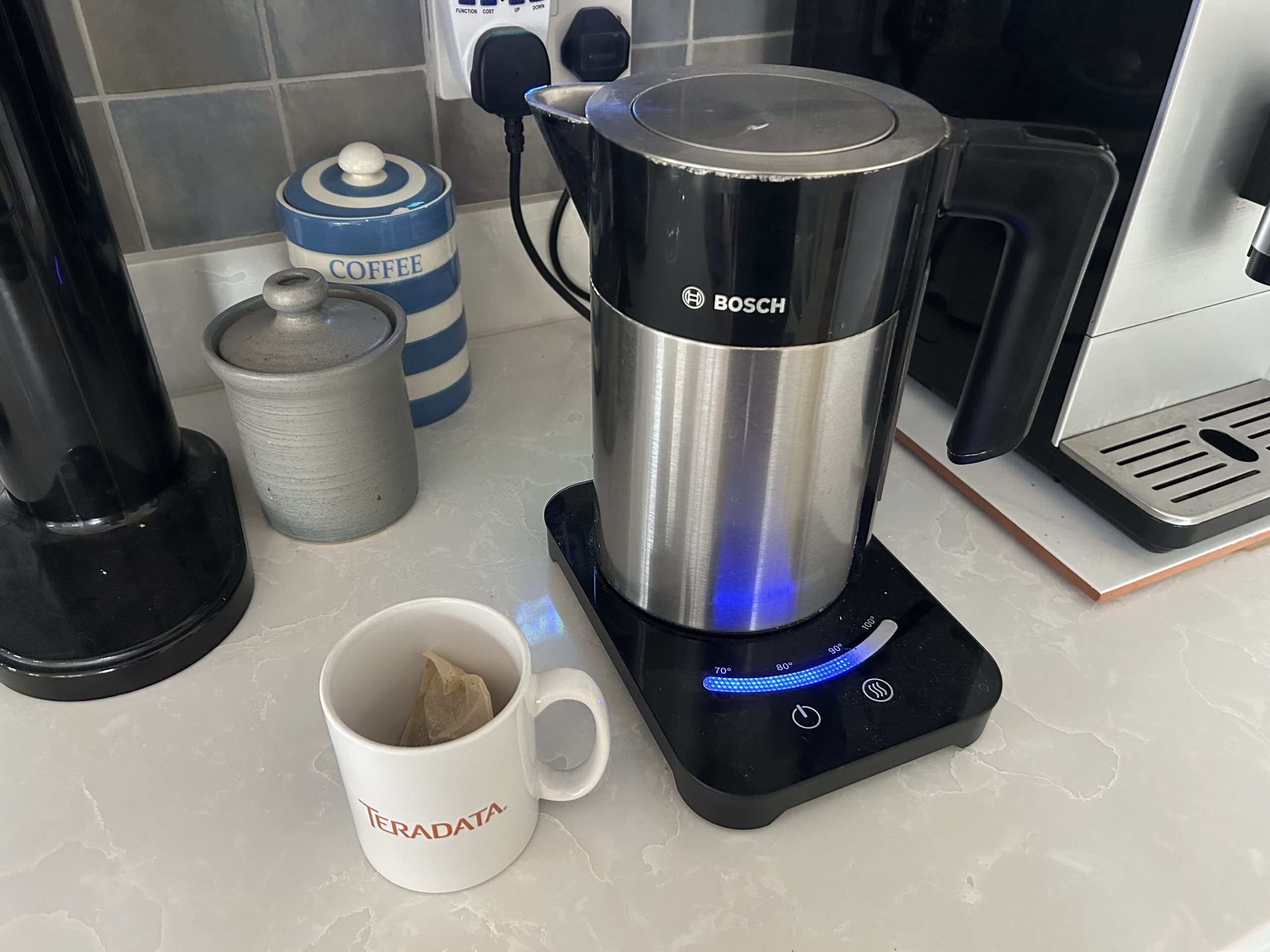
A couple of years ago we switched to a Bosch TWK7203GB variable temperature kettle. It looks like a pretty normal cordless jug kettle except it has a temperature scale on the base, so you can set the temperature of the water you want it to heat (there’s also an urn function so it can sit there keeping water at the given temperature).
As an experiment, I used a consumption meter to measure the difference in energy consumption between making my tea at 90C vs 100C. I used 300ml of cold water each time:
So, heating to 90C took 31Wh, compared to 38Wh at 100C (and saved about 5 seconds or so of boiling time) – so around a 22.5% energy saving.
There’s another reason beyond energy-saving to consider boiling tea a bit cooler. Research suggests that drinking hot beverages with a temperature of above 60C is linked with higher risks of oesophageal cancer. Cooling water from 100C to 63C takes between 9-13 minutes at room temperature, so if you regularly drink tea soon after making it, you’re putting yourself at a slightly higher risk. Not heating it as much means it cools to a safer temperature 2 or 3 minutes faster.
There are taste arguments on both sides: hotter water apparently extracts more polyphenols from tea leaves making tea feel stronger/more bitter, which can be a good thing for black tea (recommended boiling temperature 95-100C, according to Whittard), but is less good for green or white teas, where a water temperature of around 70-85C is supposed to be optimal. I drink a mixture – not at the same time, I’m not that weird – and like my tea on the stronger side, and I can’t say I’ve noticed the difference between making it with 90C and 100C water.
What’s the impact?
Over a year, heating water to 90C rather than 100C could save around 14.5kWh of energy, or about £35 of electricity at standard rates. The kettle was around £70, so we’ve likely already saved the purchase price back in the two years we’ve had it.
Leave a Reply